Honest comparison
Fred vs Alexa: Which "Home AI" Do You Actually Want?
The short answer. These two share a marketing category and almost nothing else. Alexa is a voice remote for your house: timers, music, light switches, quick questions — answered from a corporate cloud. Fred is a worker in your house: email, research, invoices, code, and family coordination, done by software installed on your own computer. If you're shopping for "a home AI," the real question is which job you're hiring for. This page separates them honestly — including the things Fred can't do. Fred is BYOK: connect your own model access, with access and usage billed separately by your chosen provider.
Straight up
What Fred does not do
Let's clear it early: Fred does not control your smart home. No lights, no thermostat, no door locks, no music on the kitchen speaker. If the thing you want says "turn it off from the sofa," buy the speaker — it's genuinely good at that, and it costs thirty dollars. Fred won't be offended. Keep both; they never meet.
The other job
What a speaker can't touch
Ask Alexa to triage two hundred unread emails and draft the six replies that matter. Ask it to research three suppliers and hand you a comparison. Ask it to draft this month's invoices, flag the unpaid one from July, and remind you who's gone quiet. It can't — not because the microphone is bad, but because none of your actual work lives inside a speaker.
It lives on your computer. That's where Fred is installed. Eighteen specialist agents — Email, Research, Bookkeeper, Social, Security, Codex Coder, Image Generator, and more — work where the work is, coordinated by one assistant you talk to like a person.
- Morning Briefing while you sleep — inbox triaged, calendar laid out, what's overdue surfaced. Scheduled, unattended, reported back.
- Drafts for your approval — replies, invoices, posts. You approve, Fred posts. Approval gates guard anything sensitive.
- Real research — reads, cross-checks, and returns a structured report, not a one-sentence answer over the speaker.
- Real building — pages, images, code: work product you can ship.
Privacy, architecturally
A cloud microphone vs a local worker
A smart speaker is a microphone wired to someone else's data centre — that's simply how it works, and you accept it for the convenience. Fred's architecture is the opposite: it runs on your hardware, and your files, memory, and credentials never leave your machine. When Fred needs AI thinking, the request travels directly from your device to the provider you chose — Claude, OpenAI, or Google Gemini on your own key, or a local model via Ollama. Six Days West never sees your traffic and collects no telemetry.
For a household, that difference compounds: the optional Fred Family upgrade adds PIN-locked private rooms for each person and Beacon, a family locator whose every position is stored and drawn only on your own machine — not on a location-data company's servers.
Voice, honestly
Yes, Fred talks — differently
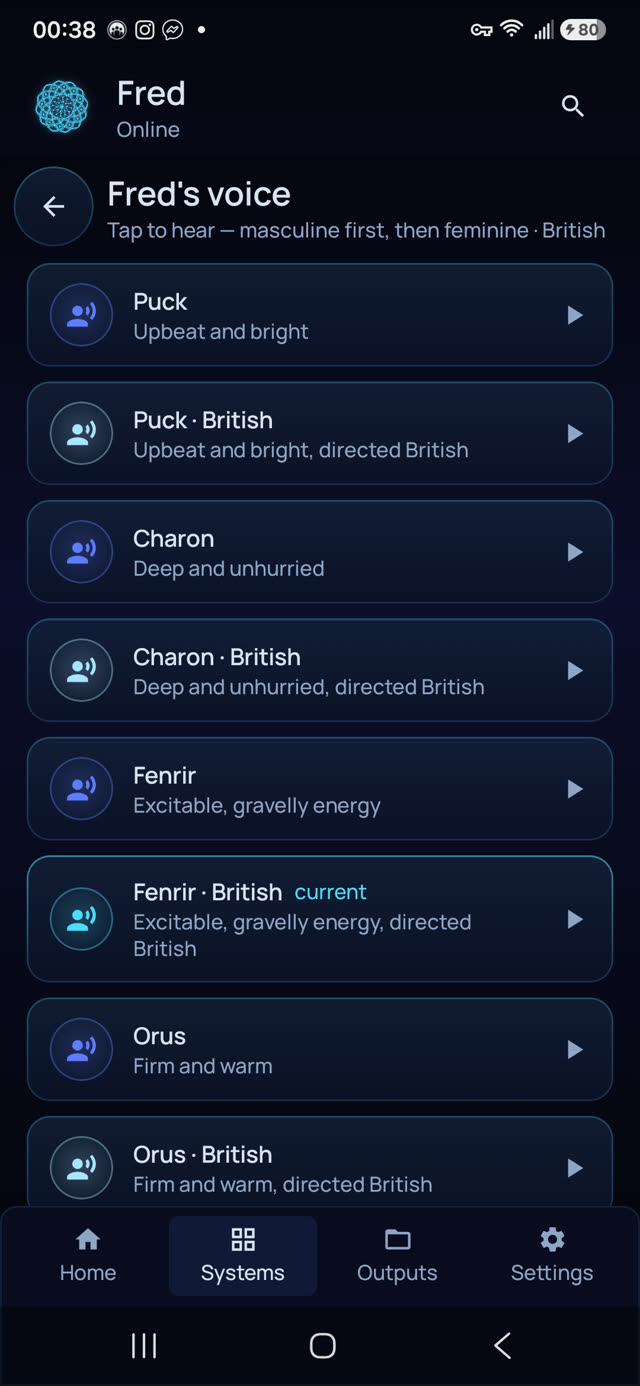
Fred's voice lives in the included Android app, which pairs to your machine over an encrypted tunnel: spoken conversation out loud, more than fifty voices to choose from, anywhere you are. It's a conversation with an assistant that knows your work — not a wake-word in the ceiling. And from any phone, including an iPhone, you can text Fred over WhatsApp or Telegram and get the same assistant, same conversation.
The decision
Hire for the job
- Buy the speaker if: you want hands-free timers, music, and light switches. It's the right tool and the right price for that job.
- Buy Fred if: you want the admin of your life and business handled — inbox, research, money paperwork, family coordination — by an assistant you own, on hardware you own, for $99 once.
- Both is normal. They cover different rooms of your life and never conflict.
Pricing
One-time. Everything from day one.
Fred’s software licence is $99. It includes the dashboard, agents, workflows, Android app, and owner’s guide. Connect your own model access; your provider bills separately for access and usage. One machine is licensed at a time, with a 14-day refund window.
Software licence: $99 once · Model-provider charges separate · 14-day refund window
FAQ
Questions people ask
Can Fred turn my lights on or play music?
No. Fred does not control smart-home devices or speakers — no lights, no thermostats, no music. If you want that, keep the smart speaker; the two coexist happily on the same household.
So what does Fred do that Alexa can't?
Real knowledge work on your own computer: triage your inbox and draft replies, research and write reports, draft invoices and track expenses, build web pages, write and run code, run scheduled briefings — through 18 specialist agents with permissions you control.
Which is more private?
They're different architectures. A smart speaker streams your voice to a corporate cloud for processing. Fred runs on your machine: files, memory, and credentials never leave it, and AI model calls go directly from your device to the provider you chose, on your own key. Six Days West collects no telemetry.
Does Fred do voice?
Yes — through the included Android app, which pairs to your machine and holds spoken conversations out loud with a choice of more than fifty voices. It's conversation with an assistant, not a wake-word speaker in the ceiling.
Do I need both?
Plenty of households will end up with both: a $30 speaker for timers and music, and Fred for the work — email, research, money admin, family coordination. They don't compete; they cover different rooms of your life.
Before you go
Not ready to spend $99? Take the honest guide instead.
The Straight-Answers Guide to Owning Your Own AI — every hard question on these pages, answered without the sales voice. Free, by email.
Software licence: $99 once · Model-provider charges separate · 14-day refund window
Keep reading