What Fred actually is
A $99 Home for Whatever AI Becomes
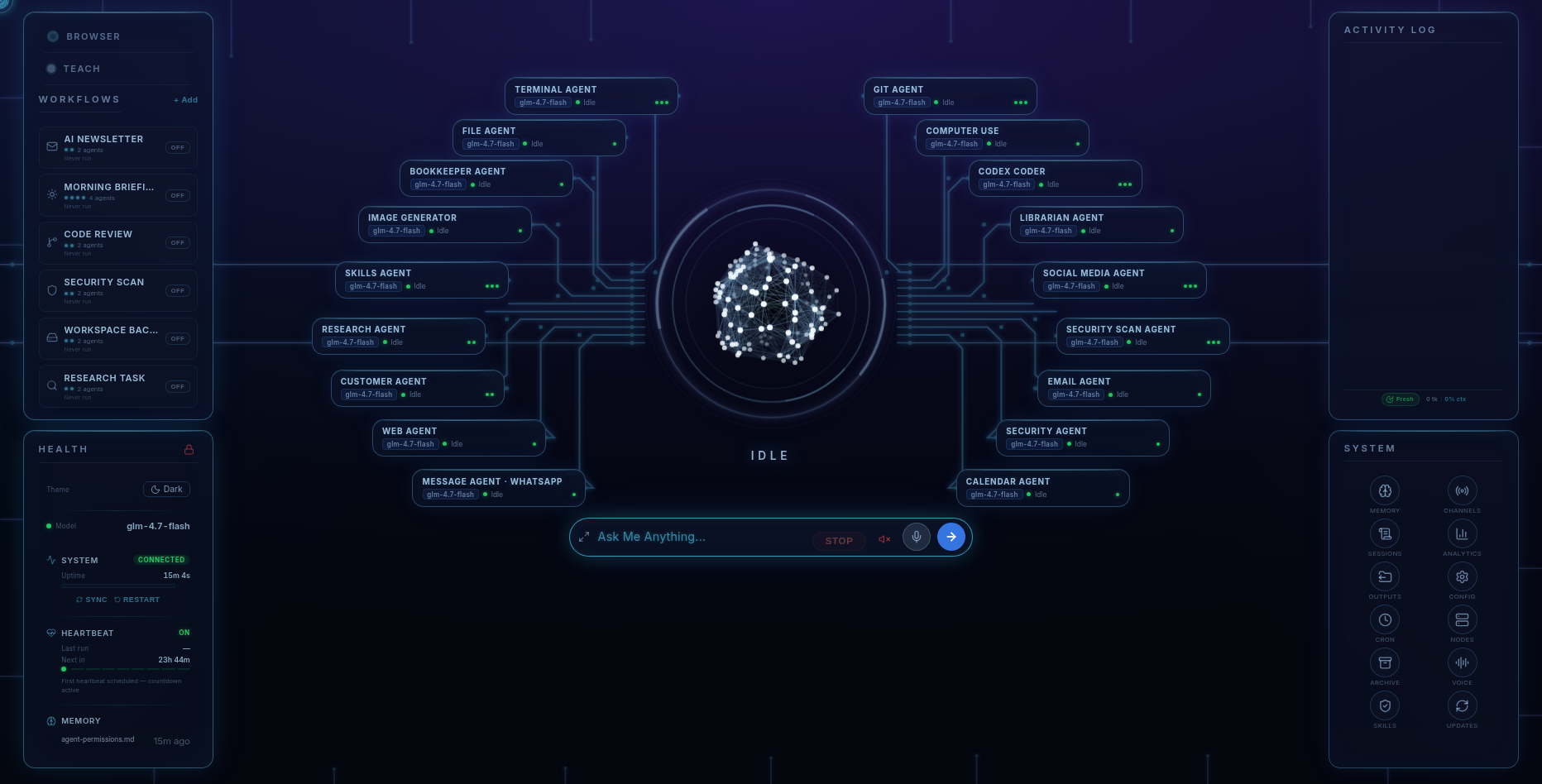
The short answer. Fred is a harness — a dashboard and control panel that turns AI models into a household assistant. That's a new kind of thing, so it deserves explaining rather than selling: think of Fred as a home built for you. The rooms, the rules, the memory of your life — that part is yours, installed on your machine, bought once for $99. The intelligence is the visitor: whichever AI model you point at it today, and whichever better one exists next year. Most software starts aging the day you buy it. A home for AI does the opposite — because the minds that visit it keep getting smarter. Fred is BYOK: connect your own model access, with access and usage billed separately by your chosen provider.
The two layers
The part you own, and the part that improves
Everything about Fred separates into two layers, and once you see them, the whole product makes sense.
- The home — stable, yours, $99 once. Eighteen specialist agents with their permissions and approval gates. Your workflows and scheduled briefings. Fred's accumulating memory of your projects and people. The family's PIN-locked rooms. The dashboard and the Android app. All of it lives on your Windows or Linux machine and maps to your life — which is exactly why it doesn't go out of date when the AI market lurches.
- The visitors — improving constantly, hired by the minute. The thinking comes from whichever model you choose on your own key — Claude, OpenAI, Google Gemini, and the rest — or from a free local model running on your own hardware via Ollama. This layer upgrades itself: the labs compete, and your home inherits the results.
Time is on your side
Why Fred gets more capable after you buy it
- Cloud lane: smarter on arrival day. When your provider ships a better model, using it in Fred is a dropdown — same agents, same memory, same workflows, now with a sharper mind. No upgrade purchase, no migration.
- Local models are another supported configuration. You provide the model and hardware, choosing a setup suited to your machine.
- The home compounds. While the visitors get smarter, the home gets wiser: Fred's memory of your business, your family, your preferences accumulates on your disk — and survives every model change, because it belongs to the home, not the visitor.
Explained, not oversold
What "forever" and "future-proof" honestly mean here
- The licence is perpetual; the updates window is a year. Fred keeps working after year one — no timer, no nag — and your first year of software updates is included. We're not promising you free engineering forever; we're saying the thing you bought doesn't stop being yours.
- Nobody can promise specific future models. We won't name what 2027's AI looks like — we've built the place it will work from, whatever it is. Provider lists grow with the open-source platform Fred is built on; what we claim is what's true today.
- Local quality still tracks your hardware today. A modest machine runs modest local models well; frontier-level local thinking still wants a serious GPU. The trend is your friend; it isn't magic.
- Internet is still required, even with a local model. Local-first, not off-grid.
The point
Ready for the world of tomorrow
Your model choice can change as providers release new options. Fred keeps the harness, tools, and memory on your machine while you choose supported model access. That access and its ongoing charges remain with your provider.
Pricing
Buy the home once
Fred’s software licence is $99. It includes the dashboard, agents, workflows, Android app, and owner’s guide. Connect your own model access; your provider bills separately for access and usage. One machine is licensed at a time, with a 14-day refund window.
Software licence: $99 once · Model-provider charges separate · 14-day refund window
FAQ
Questions people ask
What exactly is a harness?
The layer between you and AI models: a dashboard and control panel holding your agents, their permissions, your workflows, Fred's memory of you, and your family's rooms. Models supply the thinking; the harness turns thinking into your assistant. Fred is the harness — bought once, installed on your machine.
How can software get more capable after I buy it?
Fred lets you configure supported models separately from the harness. As new models become available, you can review them in the picker and test them with your own access. Availability, terms, and charges depend on the provider.
What does "$99 forever" precisely mean?
A perpetual personal licence to Fred’s software, with one year of software updates and a 14-day refund window. One machine is licensed at a time, with transfers when you change computers. Model access and usage are paid separately.
Will today's hardware run tomorrow's local models?
Local-model requirements depend on the particular model and your hardware. Choose a configuration your machine can support, or connect supported cloud-model access on your own provider account.
What if the AI landscape completely changes?
That's the scenario Fred is built for. Providers can merge, reprice, or retire models — your home doesn't move: agents, memory, files, and workflows stay on your machine, and the thinking gets re-hired from whoever's best that year.
Before you go
Not ready to spend $99? Take the honest guide instead.
The Straight-Answers Guide to Owning Your Own AI — every hard question on these pages, answered without the sales voice. Free, by email.
Software licence: $99 once · Model-provider charges separate · 14-day refund window
Keep reading